Introduction
An energy drink with Lion’s Mane combines a beverage with Lion’s Mane mushroom (Hericium erinaceus), an edible mushroom studied for its potential effects on cognitive function and mood. These drinks appeal to people looking for convenient alternatives to traditional energy drinks, particularly those interested in mental focus, productivity, and functional ingredients.
However, not every mushroom-infused drink provides the same ingredients, caffeine level, or nutritional profile. Some products contain caffeine for alertness, while others are caffeine-free. The quantity and type of Lion’s Mane used may also differ, and manufacturers do not always disclose the exact amount.
That makes choosing the right product more complicated than comparing flavors or packaging.
In this guide, we will explain what Lion’s Mane does, examine the available scientific evidence, compare several functional drinks, and discuss caffeine, sugar, safety, and ingredient transparency. By the end, you will know what to look for before buying an energy drink with Lion’s Mane—and which claims deserve a closer look.
1. What Is an Energy Drink with Lion’s Mane?

An energy drink with Lion’s Mane is a ready-to-drink beverage containing Lion’s Mane mushroom powder, extract, or another ingredient derived from the mushroom. It may also include caffeine, green tea extract, vitamins, sweeteners, electrolytes, or other functional ingredients.
Lion’s Mane is recognizable by its white, shaggy appearance. Unlike caffeine, it is not an established stimulant that reliably produces an immediate feeling of alertness.
Manufacturers often include it in products marketed for focus or cognitive performance. However, the presence of Lion’s Mane does not automatically mean a drink improves memory, concentration, or productivity.
How is it different from a regular energy drink?
Traditional energy drinks generally emphasize caffeine and may contain sugar, taurine, B vitamins, or other ingredients. Lion’s Mane beverages add a mushroom-derived ingredient that is being investigated for its possible biological effects.
The main differences depend on the individual product:
- Caffeine: Determines much of the immediate stimulating effect.
- Lion’s Mane: An ingredient with preliminary research into possible cognitive effects.
- Sugar and calories: Vary significantly between formulations.
- Additional ingredients: May include tea extracts, amino acids, vitamins, or other mushrooms.
The most important point is to evaluate the complete ingredient list rather than assuming that every functional drink offers the same benefits.
2. How Does Lion’s Mane Work?
Researchers have studied compounds in Lion’s Mane, including hericenones and erinacines, for their possible effects on biological pathways associated with the nervous system. Much of the mechanistic evidence comes from laboratory and animal research, rather than large, well-controlled human trials.
Some research investigates whether these compounds may influence nerve growth factor-related pathways and other processes associated with nerve-cell function. However, laboratory findings do not establish that drinking a commercially available energy drink produces the same effects in people.
Human research remains limited. A small pilot study involving 41 healthy adults examined Lion’s Mane supplementation over a 28-day period and reported mixed findings across cognitive and mood measures. A separate study involving 18 healthy younger adults found no significant overall improvement in composite cognitive performance after a single dose, although one individual task showed improvement.
PubMed
+1
These studies are useful starting points, but they do not prove that Lion’s Mane energy drinks improve everyday concentration or long-term brain health.
What this means for consumers: The mushroom is scientifically interesting, but claims about its effects should be treated cautiously, especially when a drink does not disclose its Lion’s Mane quantity or extract specifications.
3. Potential Benefits of Lion’s Mane Energy Drinks
Lion’s Mane beverages may appeal to consumers for several reasons. It is important, however, to distinguish potential benefits being investigated from proven outcomes.
Interest in cognitive function
Researchers have investigated Lion’s Mane for possible effects on memory, cognitive performance, and other aspects of brain function. Some small human studies have reported encouraging findings, but the evidence is not conclusive. Larger and longer trials are needed to establish which effects, if any, are reliable.
PubMed
+1
Support for alertness from caffeine
If a Lion’s Mane drink contains caffeine, that ingredient may increase alertness and reduce feelings of tiredness temporarily. The effect comes from caffeine and should not be attributed automatically to the mushroom.
A caffeine-free Lion’s Mane drink may suit someone who wants to avoid stimulants, but it should not be expected to provide the same immediate stimulation as a caffeinated beverage.
Convenient functional ingredients
Some drinks combine Lion’s Mane with vitamins, tea extracts, or other ingredients. A ready-to-drink format may be convenient for people who prefer not to prepare coffee or mix supplements.
Convenience alone does not demonstrate effectiveness, however. A product’s value depends on its ingredients, amounts, price, taste, and suitability for the individual.
Are the benefits scientifically proven?
Not fully. Current human evidence is limited, and research on isolated mushroom preparations cannot automatically be applied to energy drinks with different formulations.
PubMed
+1
Consumers should be particularly cautious about products claiming guaranteed focus, enhanced intelligence, disease prevention, or immediate cognitive improvement.
4. Do Lion’s Mane Energy Drinks Actually Give You Energy?
The answer depends on what you mean by energy.
In everyday language, energy can mean feeling more awake, having fewer feelings of tiredness, or having enough fuel for physical activity. These are different outcomes.
Caffeine and perceived alertness: Caffeine can temporarily increase alertness. A caffeinated Lion’s Mane energy drink may therefore feel similar to a conventional energy drink.
Calories and physical fuel: Sugar and other digestible carbohydrates provide calories. A sugar-free drink may have few or no calories, even if it contains caffeine.
Hydration: Water helps maintain normal hydration, but drinking an energy drink does not replace sleep or adequate nutrition.
Lion’s Mane: There is not enough evidence to conclude that Lion’s Mane in a commercial energy drink produces an immediate, noticeable energy boost.
If you feel more alert after consuming a caffeinated mushroom drink, caffeine may explain much of that immediate effect. The mushroom’s additional contribution remains uncertain.
For sustained energy throughout the day, adequate sleep, balanced meals, regular physical activity, and appropriate hydration remain important.
5. Best Energy Drinks with Lion’s Mane
If you are searching for the best Lion’s Mane energy drink, start by comparing the quantities of functional ingredients, caffeine per can, sugar, serving size, and price.
A useful comparison should also distinguish products that contain Lion’s Mane from alternatives that offer similar functional-drink positioning but do not list the mushroom.
The following products and figures are based on manufacturer pages and a recent competitor comparison. Formulations, prices, and availability can change, so check the current product label before purchasing.

1. TENZING Fiery Mango + Lion’s Mane
Lion’s Mane disclosed
TENZING’s official product page lists 500 mg of Lion’s Mane and 160 mg of caffeine per 500 ml can. It also lists magnesium, vitamin D, ginger, and cayenne. Its nutrition information gives 3.9 g of sugar per 100 ml, equivalent to approximately 19.5 g per 500 ml can.
Team TENZING
Best suited to shoppers who want a caffeinated, mango-flavoured drink with a stated Lion’s Mane amount.

2. Adapt FOCUS
Adapt’s published comparison lists 1,000 mg of Lion’s Mane, a caffeine-free formulation, and 3.2 g of sugar per 250 ml serving. It also lists ashwagandha and other functional ingredients.
SOLR
Worth comparing if you want a caffeine-free functional beverage rather than a conventional stimulant-based energy drink.
Read published product comparison

3. Grass & Co. Liquid FOCUS
A published comparison lists 1,000 mg of Lion’s Mane extract in a 250 ml can and describes the drink as caffeine-free. The same source notes that some other ingredient quantities are not published.
SOLR
An option to investigate if you prefer a smaller, caffeine-free drink.

4. SOLR
SOLR’s published comparison lists 120 mg of caffeine, 5.9 g of sugar, and 30 calories per 330 ml can. Its ingredient list includes Lion’s Mane, but the manufacturer does not publish its exact milligram quantity in that comparison.
SOLR
+1
Worth examining if you want a smaller caffeinated can and transparent caffeine information, while recognising that the mushroom dose is undisclosed.
Product comparison table
| Product | Serving size | Caffeine | Lion’s Mane | Sugar / calories |
|---|---|---|---|---|
| TENZING Fiery Mango | 500 ml | 160 mg | 500 mg | Approx. 19.5 g sugar / 80 kcal |
| Adapt FOCUS | 250 ml | Caffeine-free | 1,000 mg listed | 3.2 g sugar / 18 kcal |
| Grass & Co. Liquid FOCUS | 250 ml | Caffeine-free | 1,000 mg listed | Not published in comparison |
| SOLR | 330 ml | 120 mg | Amount not published | 5.9 g / 30 kcal |
Sources: official TENZING product information and the published SOLR comparison of UK functional drinks. Adapt and Grass & Co. figures are from that comparison, not independently verified laboratory measurements. Check current packaging and manufacturer information.
Team TENZING
+1
Which one should you choose?
- For a caffeinated Lion’s Mane drink: TENZING is the clearest option in this comparison because its manufacturer publishes both the mushroom quantity and caffeine content.
- For a caffeine-free option: Adapt FOCUS or Grass & Co. Liquid FOCUS may be worth investigating.
- For a smaller caffeinated can: SOLR publishes its caffeine and nutrition figures, but does not disclose the Lion’s Mane quantity in the comparison reviewed.
These are category-based suggestions, not proven rankings of effectiveness. A higher listed mushroom quantity does not, by itself, establish better results. Prices and availability should also be checked for your country.
6. Key Ingredients to Check Before Buying
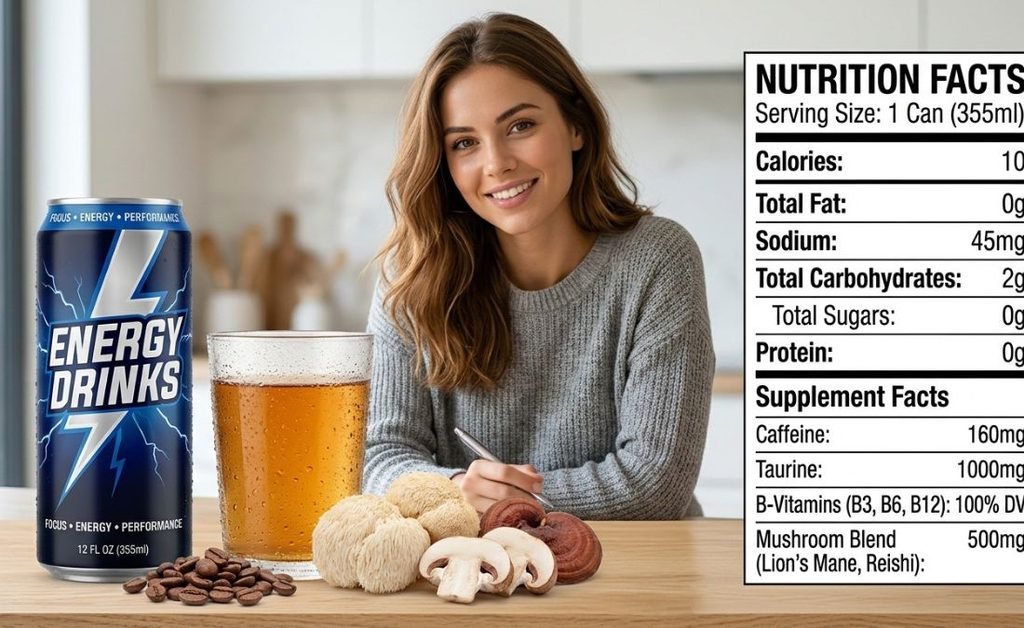
The front of a can may highlight Lion’s Mane, natural caffeine, or a focus blend. The ingredient list and nutrition panel provide more useful information.
Lion’s Mane extract versus mushroom powder
Mushroom powder and mushroom extract are not necessarily equivalent. Extraction methods and the starting material can affect the resulting composition.
Look for the amount per serving, the type of preparation, and any disclosed extract ratio or standardization information. If the label simply says “Lion’s Mane blend,” it may be difficult to determine how much mushroom ingredient the drink contains.
Fruiting body versus mycelium
The fruiting body is the visible mushroom, while mycelium is the network of fungal threads. Both can be used in mushroom products, depending on the formulation.
Neither label alone proves that a product is more effective. Preparation, composition, quality controls, and the evidence supporting the specific ingredient all matter.
Caffeine content
Always check caffeine in milligrams per full can, not just per 100 ml. For example, a drink containing 32 mg per 100 ml supplies 160 mg in a 500 ml can.
Remember to include caffeine from coffee, tea, cola, pre-workout products, and other sources in your total daily intake.
Sugar, calories, and sweeteners
Compare the full serving rather than a small reference quantity. A drink with relatively little sugar per 100 ml may still provide a substantial amount in a large can.
Also check the calorie count and whether the product uses sugar, fruit juice, non-sugar sweeteners, or a combination.
Vitamins and other functional ingredients
B vitamins, magnesium, vitamin D, L-theanine, and plant extracts may appear in functional drinks. Their presence does not automatically mean a beverage will improve energy or concentration.
Look for disclosed quantities and avoid assuming that a longer ingredient list guarantees a better product.
Third-party testing and transparency
Where available, check whether the manufacturer publishes independent testing, contaminant controls, or quality standards. A clear label is helpful, but it is not the same as independent confirmation of a product’s composition.
7. Lion’s Mane Energy Drinks vs. Regular Energy Drinks
| Feature | Lion’s Mane energy drink | Regular energy drink |
|---|---|---|
| Main selling point | Caffeine and/or functional mushroom ingredients | Usually caffeine and flavor |
| Immediate alertness | Depends largely on caffeine | Depends largely on caffeine |
| Lion’s Mane research | Preliminary human evidence; commercial drinks are not established treatments | Not applicable unless included |
| Ingredient transparency | Varies by brand | Varies by brand |
| Sugar and calories | May be high or low | May be high or low |
| Best comparison method | Read the complete label and check mushroom quantities | Read the complete label and check caffeine and sugar |
Neither category is automatically healthier or more effective. A sugar-free conventional energy drink may contain less sugar than a mushroom drink, while a caffeine-free functional beverage may be more suitable for someone avoiding stimulants.
Choose according to your needs, ingredient tolerance, budget, and the information the manufacturer provides.
8. Possible Side Effects and Safety Considerations
An energy drink with Lion’s Mane can contain several ingredients that affect people differently. The mushroom itself and the caffeine in the finished beverage should be considered separately.
Possible Lion’s Mane side effects
Lion’s Mane is an edible mushroom, but supplements and concentrated extracts are not identical to eating it as food. Reported or potential adverse effects include stomach discomfort and allergic reactions. The available safety evidence remains limited.
PubMed
Stop using a product and seek medical advice if you experience a concerning reaction. Seek urgent medical assistance for signs of a severe allergic reaction, such as difficulty breathing or swelling of the throat.
Caffeine-related effects
Depending on the dose and your sensitivity, caffeine can cause:
- Nervousness, restlessness, or jitters.
- Difficulty falling asleep or reduced sleep quality.
- A racing heartbeat or palpitations.
- Headaches or withdrawal symptoms when regular intake is reduced.
- Stomach discomfort in some people.
A drink marketed as natural is not automatically free from these effects.
How much caffeine is too much?
The US Food and Drug Administration cites 400 mg per day as an amount not generally associated with negative effects for most healthy adults, while emphasising that sensitivity varies. This is not a target intake or a guarantee of safety for every individual.
PubMed
Check the caffeine amount on your specific product, and count all other sources consumed during the day. Do not use the general adult reference as a personal limit if a healthcare professional has advised you to restrict caffeine.
Pregnant or breastfeeding individuals, children and adolescents, people with relevant medical conditions, and people taking medication should seek appropriate professional advice before consuming high-caffeine drinks or concentrated mushroom ingredients.
9. How to Choose the Right Lion’s Mane Energy Drink
Use this checklist before buying:
Pre-purchase checklist
0 of 8Check the caffeine amount per entire can.Check the stated Lion’s Mane quantity per serving.Look for extract details and ingredient transparency.Compare sugar and calories for the full serving.Review additional stimulants, vitamins, and herbal ingredients.Check the manufacturer’s quality and testing information.Compare the price per can and availability in your country.Consider your caffeine sensitivity and intended time of consumption.
Reset checklist
One of the most useful habits is to compare products using the same serving size. A 500 ml can and a 250 ml can cannot be compared fairly by looking only at their caffeine figures per can.
Also, do not assume that a product with more ingredients or a higher price delivers better results. Transparent information is more useful than impressive marketing language.
10. Who Should Consider Avoiding These Drinks?
Some people should be particularly cautious with Lion’s Mane energy drinks.
- People sensitive to caffeine: Consider caffeine-free alternatives if caffeine triggers anxiety, jitters, palpitations, or sleep problems.
- People with sleep difficulties: Avoid consuming caffeinated beverages close to bedtime.
- People with mushroom allergies: Avoid products containing Lion’s Mane unless a qualified healthcare professional advises otherwise.
- People with relevant medical conditions or taking medication: Ask a healthcare professional or pharmacist about possible ingredient interactions.
- Pregnant or breastfeeding individuals: Obtain appropriate medical guidance before using concentrated functional ingredients or high-caffeine products.
- Children and adolescents: Energy drinks are generally not appropriate for this age group; avoid using them as a way to manage fatigue or concentration problems.
If you regularly feel exhausted despite getting adequate sleep, consider discussing the persistent fatigue with a healthcare professional instead of relying on energy drinks to mask it.
11. Frequently Asked Questions
1. What is an energy drink with Lion’s Mane?
It is a beverage containing Lion’s Mane mushroom, sometimes combined with caffeine, vitamins, sweeteners, or other functional ingredients. The exact formulation varies by brand.
2. Does Lion’s Mane give you energy?
Lion’s Mane is not an established stimulant like caffeine. Research is exploring possible cognitive effects, but there is insufficient evidence that it provides an immediate energy boost in commercial drinks.
3. Can Lion’s Mane help with focus?
Some early human studies have explored cognitive performance, but the results are limited and mixed. It has not been established that Lion’s Mane energy drinks reliably improve focus in healthy adults.
PubMed
+1
4. Do Lion’s Mane energy drinks contain caffeine?
Some do and others do not. For example, TENZING Fiery Mango + Lion’s Mane lists 160 mg per 500 ml can, while Adapt FOCUS is listed as caffeine-free in a published comparison.
Team TENZING
+1
5. Are Lion’s Mane energy drinks safe?
Safety depends on the formulation, caffeine quantity, serving size, individual health, and potential allergies or interactions. Check the label and seek professional guidance if you have relevant health concerns.
6. How much caffeine is in a Lion’s Mane energy drink?
There is no universal amount. TENZING lists 160 mg per 500 ml can, while SOLR lists 120 mg per 330 ml can. Some functional mushroom drinks are caffeine-free.
Team TENZING
+1
7. Can you drink a Lion’s Mane energy drink every day?
Daily use cannot be recommended universally. Consider the complete caffeine intake, sugar, other ingredients, and individual tolerance. Evidence does not establish that daily consumption of these drinks provides reliable cognitive benefits.
8. What should you check before buying one?
Check caffeine per can, Lion’s Mane quantity, extract details, sugar, calories, additional ingredients, quality information, price, and serving size. Avoid relying on health claims that are not supported by suitable evidence.

12. Final Verdict
An energy drink with Lion’s Mane may appeal to people interested in functional beverages, mushroom ingredients, and alternative approaches to their daily routine. However, the presence of Lion’s Mane does not prove that a drink improves focus, memory, or long-term brain health.
If you are comparing available products, begin with the facts: caffeine per can, the stated amount of Lion’s Mane, sugar, calories, and the transparency of the ingredient list. TENZING Fiery Mango + Lion’s Mane is one example of a product that publishes both its mushroom quantity and caffeine content. Caffeine-free options such as Adapt FOCUS may be more relevant to consumers who prefer to avoid stimulants, although they should not be expected to provide caffeine-like alertness.